
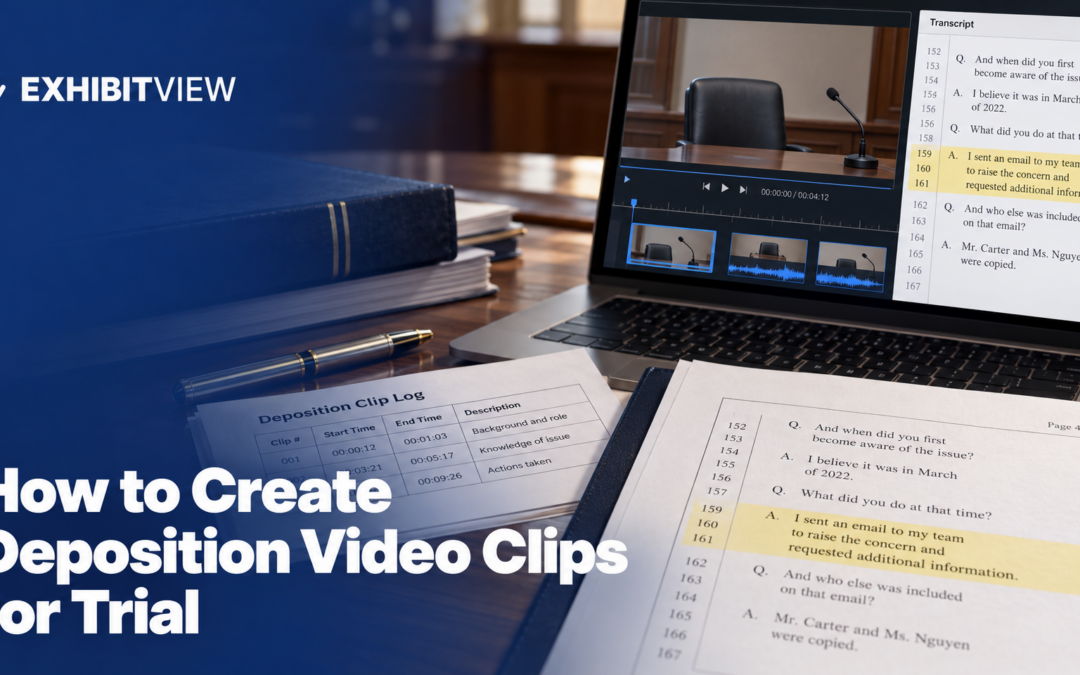
A deposition clip is only useful if it plays on time, matches a transcript, and reaches the other side and the court the way the court says it must. Building clips by hand, one page and line at a time, is slow work. This guide covers the rules that frame video testimony, how courts handle edited video, file formats and delivery, a method for building clips, a log you can copy, and a playback check.
Key takeaways
- Clips come from designations. Rule 26(a)(3) calls for pretrial disclosure of the witnesses whose testimony you expect to present by deposition and, if it was not taken stenographically, a transcript of the pertinent parts.
- Expect a matching transcript and a deadline. W.D. Ark. Judge Brooks requires a transcript that corresponds exactly to the edited video, and D. Neb. requires a copy of the edited video at least 7 days before it is shown.
- Check the file type early. N.D. Ill. Judge Valderrama’s list of accepted video types has no .mp4, while a Dallas County court asks for MP4 cuts.
- ExhibitView’s TranscriptPro lists designations, summaries, issue lists and sending clips to Trial Presenter, and ExhibitView says its desktop products are designed for Windows.
What do the rules say about video testimony?
Rule 26(a)(3)(A)(ii) requires pretrial disclosure of the witnesses whose testimony you expect to present by deposition and, if the deposition was not taken stenographically, a transcript of the pertinent parts. The disclosures exclude evidence used solely for impeachment. Unless the court orders otherwise, they are due at least 30 days before trial. Within 14 days after they are made, unless the court sets a different time, a party may serve and promptly file objections to the use of a designated deposition under Rule 32(a), and an objection not made is waived unless excused for good cause, except objections under Evidence Rules 402 and 403.
Rule 32(c) says that, unless the court orders otherwise, a party must provide a transcript of any deposition testimony it offers, and may provide the testimony in nontranscript form as well. On any party’s request, testimony offered in a jury trial for any purpose other than impeachment must be presented in nontranscript form, if available, unless the court for good cause orders otherwise. In a jury trial, that can mean clips.
What do courts require for edited video?
Local procedures differ. Four published examples on timing and transcripts:
|
Court |
Timing |
Transcript |
Also says |
|---|---|---|---|
|
W.D. Ark., Judge Brooks |
The final edited video and transcript go to opposing counsel at least one full business day before trial, and to the courtroom deputy by the first morning |
A transcript that corresponds exactly to the edited video |
The proponent edits the video after the court rules on objections |
|
D. Neb., NECivR 32.1 (effective Dec 1, 2025) |
A copy of the edited video goes to opposing attorneys at least 7 days before it is shown |
Not addressed in the rule |
The proponent bears the editing cost. Overruled objections need not be deleted. The other side may object only if the edit departs from the parties’ agreement or the court’s ruling, or the video quality makes it hard for the jury to follow. Written objections are due 24 hours before |
|
N.D. Cal., Judge Breyer |
Testimony to other parties at least 5 calendar days before use, and a final packet to the court at least 2 calendar days before |
Packets are prepared even when video will be played |
The video should omit dead time, long pauses and objections or colloquy not necessary to understand the answers. This part applies only to witnesses who appear by deposition |
|
N.D. Ill., Judge Valderrama |
Final transcripts to be read in place of live testimony go to chambers 5 days after the pretrial conference, unless the minute entry says otherwise |
Redact sustained objections and remove overruled ones from the transcript |
A person sits on the stand to read answers when a transcript is read instead of live testimony |
Examples from each court’s published information. Confirm the current version before relying on them. Your judge’s orders can differ.
What file format and delivery do courts ask for?
The answers differ, and small details cause trouble on the day:
- Judge Valderrama (N.D. Ill.). Its jury evidence system accepts .avi, .wmv, .mpg, .mp3, .wma and .wav for video and audio. No .mp4 appears in the list.
- D. Or. The JERS page lists .avi, .mpg, .mp3 and .mp4 for audio and video recordings, and was last updated in June 2025.
- Judge Settle (W.D. Wash.). Audio and video must play in Windows Media Player or VLC, and files that need their own codec or player must be converted.
- County Court at Law No. 4, Dallas County. If video deposition testimony will be offered in place of live testimony, give the reporter MP4 video cuts and the excerpt transcript that reflects them.
- One N.D. Cal. case order (Judge Ryu, July 2025). The parties were to lodge a USB drive with clips of only the admitted designations within two business days after admission. This is one case’s order and not a district rule.
How do you build the clips?
- Start from the final designations. Use your designations and the other side’s counter-designations as ruled on. Cutting before the rulings means cutting twice.
- Cut at natural boundaries. Start where a question begins and end after the answer finishes, so a clip does not open mid-sentence.
- Trim what the court tells you to trim. Judge Breyer’s guidance is dead time, long pauses and unneeded objections. D. Neb. keeps overruled objections in unless you choose otherwise.
- Match the transcript to the video. Build a transcript that tracks each clip line for line, as Judge Brooks requires. Check each line against what the video says.
- Name and order the clips. Use witness, page and line in the name, and play clips in the order of the transcript.
- Deliver on the court’s schedule. Use the earliest deadline that applies.
Here is a clip log you can copy, with an invented example row:
|
Clip |
Witness |
Page:line |
Length |
Ruling |
Delivered? |
|---|---|---|---|---|---|
|
Ruiz_088-004_to_089-011 (invented example) |
Dana Ruiz |
88:4 to 89:11 |
1:05 |
Objection overruled |
Yes, 11/2 |
What if the other side counter-designates?
If you offer only part of a deposition, Rule 32(a)(6) lets the adverse party require you to introduce other parts that in fairness should be considered with the part you offered, and lets any party introduce other parts itself. Judge Brooks has the counter-designations merged chronologically into one joint form for each witness. Judge Breyer says a completeness objection should normally be made only if a few extra lines will cure the problem. Build your clips so a counter-designation can be played right after yours in the same order as the transcript.
How do you check the clips before trial?
Watch every clip start to finish, with the transcript in hand and the sound on. Then test playback on the equipment you will use. Judge Boone’s Courtroom 9 document (E.D. Cal., revised November 2024) says no court or jury time will be provided for the parties to troubleshoot their equipment or the courtroom’s. Keep a second copy on a drive, and have the transcript pages ready for any clip you cannot play.
Where does software fit?
You can cut clips by hand, but the work grows with the witnesses. ExhibitView’s TranscriptPro lists designations, summaries and issue lists, and sending testimony, clips and exhibits to Trial Presenter. Trial Presenter lists synchronized video depositions. ExhibitView says its desktop products are designed for Windows. The pages do not list clip file formats, so test exported clips against your court’s list.
What is the checklist for deposition clips?
- Your designations are final, and the court has ruled on objections.
- Each clip starts and ends at natural boundaries.
- Dead time and unneeded colloquy are trimmed as the court directs.
- A transcript matches each clip line for line.
- The files are in a type your court accepts.
- The log shows witness, page and line, length, ruling and delivery date.
- You know every deadline that applies and have beaten the earliest.
- Every clip has been watched start to finish and tested on the courtroom setup.
- A second copy and the transcript pages are at counsel table.
Conclusion
Build your clips from the final designations and rulings, match a transcript to each one, and find out your court’s deadline and file type before you cut anything. Watch every clip start to finish, test the exported files on the courtroom’s equipment, and keep a second copy ready.
About ExhibitView
ExhibitView makes trial presentation software for lawyers and paralegals, including TranscriptPro for managing deposition transcripts and Trial Presenter for showing exhibits and clips in court. ExhibitView says its desktop products are designed for Windows, and iTrial is an iPad app for presenting. A short call can show whether it fits your cases.
Book a 15-minute call with Bill
Frequently Asked Questions
How far ahead must you give the other side your clips?
It depends on the court. D. Neb. requires the edited video at least 7 days before it is shown, W.D. Ark. Judge Brooks requires it at least one full business day before trial, and N.D. Cal. Judge Breyer requires testimony at least 5 calendar days before use. Check your judge’s orders.
Do you have to cut out the objections?
Not necessarily. D. Neb. says overruled objections need not be deleted, and N.D. Cal. Judge Breyer asks you to omit objections and colloquy not necessary to understand the answers. Follow the court’s rulings and orders.
Do you need a transcript of the clips?
Usually. Rule 32(c) says a party must provide a transcript of any deposition testimony it offers unless the court orders otherwise, and W.D. Ark. Judge Brooks requires a transcript that corresponds exactly to the edited video.
Can the other side object to your edited video?
In D. Neb., only if the edit does not follow the parties’ agreement or the court’s ruling, or if the video quality makes it difficult for the jury to understand. Objections must be in writing, at least 24 hours before the video is shown.
Can you use clips to impeach a witness?
Yes. Any party may use a deposition to contradict or impeach the deponent as a witness (Rule 32(a)(2)). Rule 32(c)’s nontranscript requirement applies to testimony offered for purposes other than impeachment.
What file format should clips be in?
Ask the court. Judge Valderrama’s list has no .mp4, D. Or. lists .mp4, a Dallas County court asks for MP4 cuts, and Judge Settle requires playback in Windows Media Player or VLC.
Recent Comments