
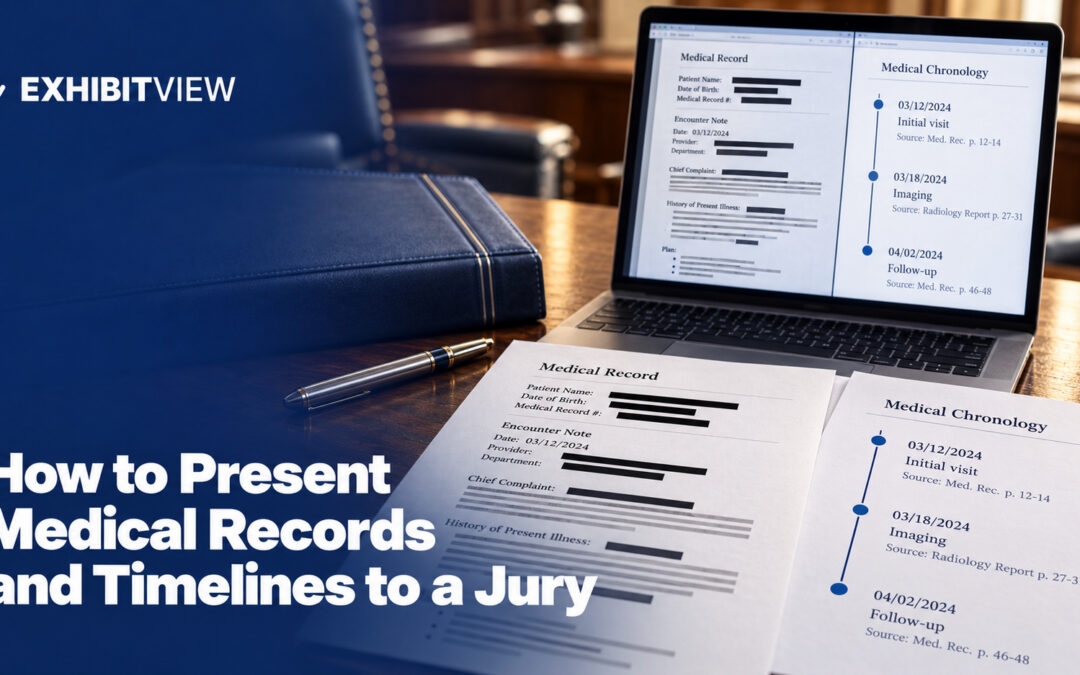
Medical records are often the backbone of an injury or malpractice trial, and they are also dense, technical and full of hearsay. This guide covers how the records get into evidence, how a timeline differs from a summary, how to build a timeline a jury can follow, and what to check before you show it.
Key takeaways
- Records need a path in. Under Rule 803(6), the foundation can come from a custodian’s testimony or a Rule 902(11) certification, which requires advance written notice.
- Statements in a record can be a separate question. Rule 803(4) covers statements made for, and reasonably pertinent to, medical diagnosis or treatment, and the committee note says a statement about fault would not qualify.
- A timeline is either an illustrative aid under Rule 107, which is not evidence, or a Rule 1006 summary of voluminous admissible records, which can be evidence. Decide which before you build it.
- ExhibitView’s Trial Presenter lists side-by-side display and live markup, so a timeline can sit next to the record page it cites, and its PDF+ lists Bates numbering and redaction for preparing the pages.
How do you get medical records into evidence?
The usual route is Rule 803(6). A record of an act, event, condition, opinion or diagnosis qualifies if five things hold:
- it was made at or near the time by, or from information transmitted by, someone with knowledge;
- it was kept in the course of a regularly conducted activity of a business, organization, occupation or calling, whether or not for profit;
- making the record was a regular practice of that activity;
- the custodian or another qualified witness shows those conditions, or a certification that complies with Rule 902(11) or (12) or a statute permitting certification does; and
- the opponent does not show that the source of information or the method or circumstances of preparation indicate a lack of trustworthiness.
You have two ways to show the foundation:
|
Route |
What it takes |
Have ready |
|---|---|---|
|
Custodian or qualified witness |
Testimony at trial or by deposition that the Rule 803(6) conditions are met |
The witness, or the testimony |
|
Certification under Rule 902(11) |
A custodian’s certification that meets Rule 803(6)(A) to (C). The proponent must give reasonable written notice before trial and make the record and certification available for inspection |
The signed certification, a notice and proof of service |
Check your court’s schedule for objections to certifications and your state’s version of these rules, since state rules on medical records can differ.
What about statements inside the records?
A chart can hold statements from the patient, family or providers. Under Rule 803(4), a statement is covered if it is made for, and reasonably pertinent to, medical diagnosis or treatment, and it describes medical history, past or present symptoms or sensations, their inception or their general cause. The committee note gives an example: a patient’s statement that he was struck by an automobile would qualify, but not his statement that the car was driven through a red light. Plan how each important entry comes in, since a record can clear one hurdle and still raise another.
What is the difference between a timeline and a summary?
Writings, charts and calculations used at trial fall into two groups, and the rules differ:
|
Illustrative aid |
Rule 1006 summary |
|
|---|---|---|
|
Purpose |
Helps the jury understand evidence or argument |
Proves the content of voluminous admissible records |
|
Evidence? |
No |
Can be admitted as evidence |
|
Rule |
||
|
Jury room |
Not by default. Only if all parties consent or the court orders it for good cause |
Treated as evidence if admitted |
Rule 1006(a) lets the court admit a summary, chart or calculation offered to prove the content of voluminous admissible writings, recordings or photographs that cannot be conveniently examined in court, whether or not they have been introduced into evidence. Under Rule 1006(b), the proponent must make the underlying originals or duplicates available for examination or copying by other parties at a reasonable time and place, and the court may order them produced in court. Rule 1006(c) says a summary that functions only as an illustrative aid is governed by Rule 107. The 2024 committee note adds that a summary must also pass the Rule 403 balancing test, so one that is inaccurate or argumentative risks exclusion. For an illustrative aid, Rule 107(c) says that when practicable it must be entered into the record. N.D. Ill. Judge Valderrama’s order has parties list Rule 1006 summaries and proposed demonstratives on their exhibit charts.
How do you build a medical timeline a jury can follow?
Start from the records you expect to be admitted, then add structure:
- One row per event. Give the date, the source page and a short plain-language description.
- Cite every entry. Use the Bates number or page of the record, so anyone can check it.
- Translate terms. Keep the chart’s term and add what it means in plain words.
- Keep argument out. The Rule 107 committee note warns that an illustrative aid may be prepared to distort or oversimplify the evidence, so leave conclusions to your argument.
- Test it with a colleague. Ask someone outside the case to read it and say what happened.
An invented example row: “March 3 | Chart page BATES 000412 | Visit for knee pain; exam and X-ray ordered.” The date, page and entry are all made up for illustration.
How do you protect patient information?
Check what the records contain before they go on a screen or into a filing. Rule 5.2 says that, unless the court orders otherwise, a filing may include only the last four digits of a Social Security or taxpayer identification number, the year of a birth date, a minor’s initials and the last four digits of a financial account number. Ask whether your exhibits will be filed and whether a protective order or sealing applies, and redact before you show or file. State privacy rules may add more, so check yours.
How do you show the record during testimony?
Pair the timeline with the page it cites. When a witness explains an entry, show the record page and the relevant lines side by side, and ask the court’s permission to publish only what has been admitted. A California Lawyers Association article reprinted from CEB advises showing the actual evidence, cropped or called out as needed, so that jurors’ eyes are drawn to the most important part.
Where does software fit?
You can build a timeline in a slide or spreadsheet file. The records themselves need clean, numbered, searchable pages. ExhibitView’s PDF+ lists Bates numbering, redaction and OCR, and Trial Presenter lists side-by-side display and live markup. ExhibitView says its desktop products are designed for Windows.
What is the checklist for medical records and timelines?
- Each record has a path in: a witness or a Rule 902(11) certification with notice.
- Each key entry has a plan under Rule 803(4) or another route.
- You know whether each chart is a Rule 107 aid or a Rule 1006 summary.
- For a Rule 1006 summary, the underlying records are available to the other side.
- Every timeline entry cites a page or Bates number.
- Identifiers are redacted, and any protective order is followed.
- Callouts are ready for the pages you will show.
Conclusion
Decide how each medical record gets in, and whether each timeline is an illustrative aid or a Rule 1006 summary, before you build anything. Cite a page or Bates number on every entry, redact identifiers, and show the record page beside the timeline when the witness explains it.
About ExhibitView
ExhibitView makes trial presentation software for lawyers and paralegals, including Trial Presenter for showing exhibits in court and PDF+ for preparing documents. ExhibitView says its desktop products are designed for Windows, and iTrial is an iPad app for presenting. A short call can show whether it fits your cases.
Book a 15-minute call with Bill
Frequently Asked Questions
Can medical records come in without a witness?
Sometimes. Under Rule 803(6), the foundation can be shown by a Rule 902(11) certification, which requires reasonable written notice to the other side before trial and access to the record and certification.
Are statements to a doctor hearsay?
They can be, but Rule 803(4) covers statements made for, and reasonably pertinent to, medical diagnosis or treatment. The committee note says a statement that a car was driven through a red light would not qualify.
Is a medical timeline evidence?
It depends on its purpose. If it only helps the jury follow the evidence, it is an illustrative aid under Rule 107 and is not evidence. If it proves the content of voluminous admissible records, Rule 1006 may allow it as evidence.
Can a timeline go to the jury room?
Under Rule 107(b), an illustrative aid is not evidence and must not be provided to the jury during deliberations unless all parties consent or the court, for good cause, orders otherwise. A Rule 1006 summary admitted as evidence is treated as evidence.
Do you have to share the records behind a summary?
For a Rule 1006 summary, the proponent must make the underlying records available to the other parties at a reasonable time and place. Check any local deadlines for making them available.
Should you redact medical records before trial?
Check Rule 5.2, any protective order and your state’s privacy rules. Redact personal identifiers before filing or showing exhibits, and ask the court how it wants redactions handled.
Recent Comments