
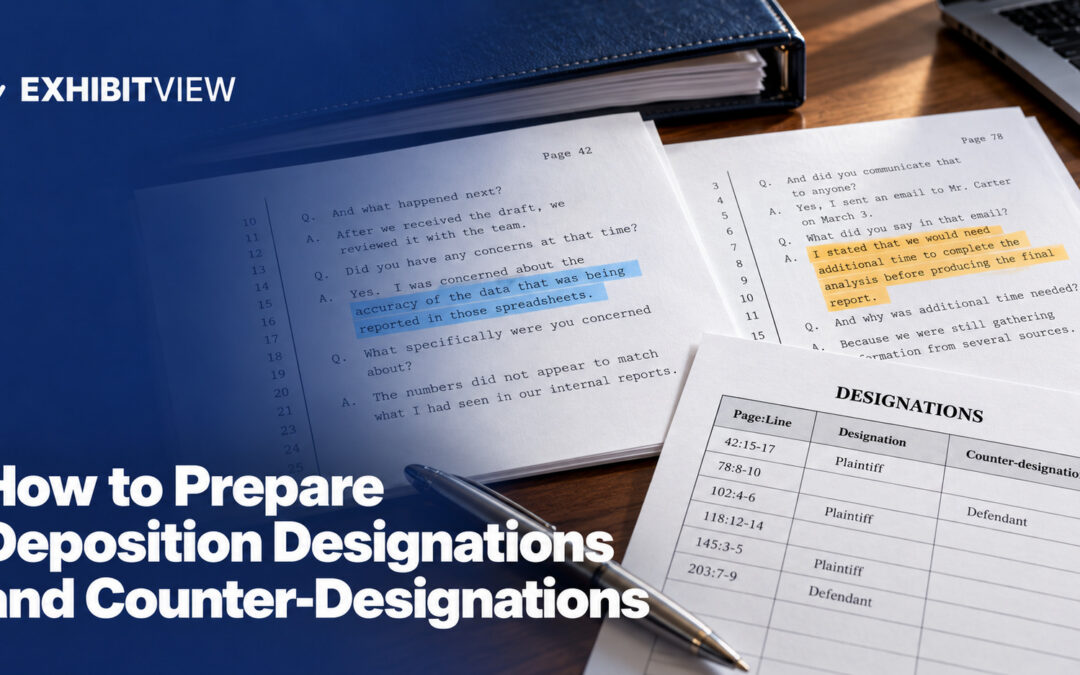
Designating deposition testimony looks like a transcript task, and typing page and line ranges by hand is tedious. Most of the work is a back-and-forth with the other side and the court. This guide covers what a designation contains, how counter-designations and completeness work, how objections and waiver work, and how the packet reaches the jury.
Key takeaways
- Work to the court’s schedule. N.D. Cal. Judge Breyer wants designations to other parties at least five calendar days before use, N.D. Ill. Judge Valderrama wants a designation chart with the pretrial statement, and W.D. Ark. Judge Brooks has the parties exchange page and line designations by the case management order’s deadline.
- Completeness is built into Rule 32(a)(6). If you offer only part of a deposition, an adverse party may require you to introduce other parts that in fairness should be considered with it, and any party may introduce other parts itself.
- Waiver depends on the objection. Rule 32(d)(3) says objections to competence, relevance or materiality are not waived by silence at the deposition unless the ground could have been corrected then, while objections to an error or irregularity in the manner of taking it are waived if not timely made then.
- ExhibitView’s TranscriptPro page lists designations, summaries and issue lists, and sending testimony to Trial Presenter, and ExhibitView says its desktop products are designed for Windows.
What does a designation contain?
A designation is the page and line range you will offer, plus whatever the court asks you to say about it. Three published examples:
|
Court |
What it asks for |
|---|---|
|
N.D. Ill., Judge Valderrama |
A chart with the witness, the page and line designations, a description of the testimony, and its relevance. The other side adds an objection column to the Word version, with a concise basis for each objection |
|
N.D. Cal., Judge Breyer |
For witnesses who appear by deposition, a packet: the cover page, the page where the witness is sworn, and each page with proffered testimony, with unproffered portions and objections or colloquy crossed out unless needed to understand the question. Exhibit numbers conform to the trial numbers |
|
W.D. Ark., Judge Brooks |
The parties exchange page and line designations by the case management order’s deadline, and the counter-designations are interspersed chronologically in one joint designation form for each witness |
Each comes from the court’s published information. Confirm the current version before relying on it. Judge Breyer’s document is a set of civil bench-trial guidelines, and its Part VI does not apply to live witnesses whose depositions are read in while they are on the stand. Your judge’s orders can differ.
How do counter-designations and completeness work?
Rule 32(a)(6) lets an adverse party require the offeror to introduce other parts that in fairness should be considered with the part introduced, and lets any party introduce other parts itself. Courts turn that into a process:
- Judge Breyer has the other parties return the packet, marking passages they object to in yellow and additional passages needed to cure a completeness objection in blue. A completeness objection should normally be made only if a few extra lines will cure the problem, and counter-designations come back at the same time.
- Judge Brooks has one joint form per witness, with the opposing parties’ counter-designations chronologically interspersed.
How do objections and waiver work?
Under Rule 32(b), an objection may be made at a hearing or trial to the admission of deposition testimony that would be inadmissible if the witness were present and testifying, subject to Rules 28(b) and 32(d)(3). Rule 32(d)(3) separates the groups. Objections to competence, relevance or materiality are not waived by failing to object before or during the deposition, unless the ground might have been corrected then. Objections to an error or irregularity at an oral examination are waived if they relate to the manner of taking the deposition, the form of a question or answer, the oath, a party’s conduct or other matters that might have been corrected then, and are not timely made during the deposition. Objections to the form of a written question have their own deadline.
Courts and Rule 26(a)(3)(B) add deadlines. Under Rule 26(a)(3)(B), within 14 days after the pretrial disclosures, unless the court sets a different time, a party may serve and promptly file objections to the use of a deposition designated by another party, and an objection not made is waived unless excused for good cause, except one under Evidence Rule 402 or 403. Judge Valderrama has the other side add objections in a column of the chart, and says objections not included on the exhibit chart are deemed waived apart from foundation unless the objecting party shows an absence of prejudice or good cause.
How do you build the final packet and present it?
After objections are resolved, assemble what the court will use. Judge Breyer’s guidelines have the proffering party give the court a final packet, with objections and responses, at least two calendar days before it is used, and say argument ordinarily will not be needed. Judge Valderrama’s order says that if the court sustains an objection, the entire objected-to portion of the transcript should be redacted, and if it overrules one that appears in the transcript, the objection should be removed. It also says a party reading deposition testimony in place of live testimony should plan for a person to sit on the stand and read the answers aloud.
Under Judge Breyer’s guidelines, the examiner reads the questions from the lectern while a colleague sits in the witness stand and reads the answers. For video, the packets are still prepared, and the video should omit dead time, long pauses and objections or colloquy not necessary to understand the answers. Rule 32(c) adds that, unless the court orders otherwise, a party must provide a transcript of any deposition testimony it offers, and that on any party’s request, testimony offered in a jury trial for any purpose other than impeachment must be presented in nontranscript form, if available, unless the court for good cause orders otherwise.
What routine can you copy?
|
Step |
What to do |
Output |
|---|---|---|
|
1 |
Pick the witnesses you will present by deposition, and the legal basis for each |
Witness list with Rule 32 basis |
|
2 |
Choose page and line ranges and write a one-line purpose for each |
Designation chart |
|
3 |
Check exhibit references against trial exhibit numbers |
Conformed excerpts |
|
4 |
Serve on the date the court sets |
Proof of service |
|
5 |
Review the other side’s designations, and mark objections and completeness additions |
Objection and counter-designation chart |
|
6 |
Meet and confer, then assemble the final packet |
Packet with objections and responses |
|
7 |
Prepare the read-in or the video clips |
Reader assignment or clip list |
Where does software fit?
A spreadsheet and a marker pen can run a designation exchange. When the volume grows, tracking ranges across witnesses is where software helps. ExhibitView’s TranscriptPro page lists designations, summaries and issue lists, and sending testimony, clips and exhibits to Trial Presenter, which lists synchronized video depositions. ExhibitView says its desktop products are designed for Windows. The pages do not say whether counter-designations can be tracked separately, so ask.
What is the checklist for designations and counter-designations?
- You know the court’s deadlines for designations, counter-designations and objections.
- Each designation has a page and line range, a purpose and a Rule 32 basis.
- Exhibit references match trial exhibit numbers.
- You have marked objections and completeness additions for the other side’s designations.
- You know which objections would be waived if you stay silent.
- The final packet includes objections and responses.
- A reader is assigned for each read-in, or clips are ready for each video.
- Redactions follow the court’s rulings.
Conclusion
Learn your court’s schedule and packet format first, then work through the exchange step by step: designations, objections, counter-designations and the final packet. Keep a chart that shows page and line, purpose, objections and rulings for every witness, so the read-in or the clips follow the court’s rulings exactly.
About ExhibitView
ExhibitView makes trial presentation software for lawyers and paralegals, including TranscriptPro for managing deposition transcripts and Trial Presenter for showing exhibits and video in court. ExhibitView says its desktop products are designed for Windows, and iTrial is an iPad app for presenting. A short call can show whether it fits your cases.
Book a 15-minute call with Bill
Frequently Asked Questions
What is a counter-designation?
It is testimony the other side asks to add to your designation. Rule 32(a)(6) allows an adverse party to require you to introduce other parts that in fairness should be considered with the part you offered, and lets any party introduce other parts itself.
When are objections to deposition testimony waived?
It depends on the objection. Rule 32(d)(3) says objections to competence, relevance or materiality are not waived by silence at the deposition unless the ground could have been corrected then, but objections to form and similar irregularities are waived if not timely made then. Courts also set deadlines, so check yours.
Do you need to file designations for impeachment?
Not under Judge Valderrama’s order, which says a party does not need a designation chart for transcripts used to impeach a witness or refresh recollection. Other judges may differ.
Who reads the transcript to the jury?
Under Judge Breyer’s guidelines, the examiner reads the questions from the lectern and a colleague reads the answers from the witness stand. Judge Valderrama’s order has a person sit on the stand and read the answers.
Can you insist on video instead of a transcript?
Under Rule 32(c), on any party’s request, deposition testimony offered in a jury trial for any purpose other than impeachment must be presented in nontranscript form, if available, unless the court for good cause orders otherwise.
Recent Comments