
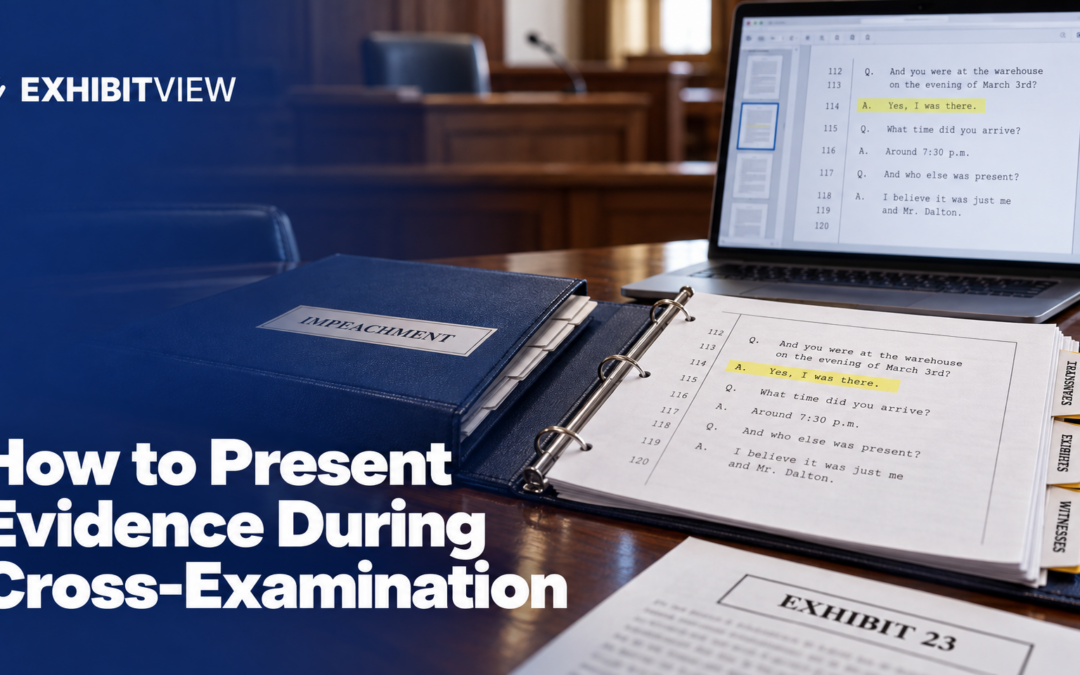
Cross-examination moves fast, and the exhibit you need is often one you hoped not to use. This guide covers what the rules allow on cross, how courts treat impeachment exhibits and exhibits that are not yet admitted, three routes for using a prior statement, a cross kit you can build before trial, and a checklist for the day.
Key takeaways
- Cross-examination ordinarily allows leading questions, and it reaches the subject matter of the direct and credibility, though the judge can allow more (Rule 611(b) and (c)).
- Prepare impeachment material in advance and in its own place. One N.D. Ill. judge asks for a separate folder, numbered at least 50 after your last exhibit, and one N.D. Cal. judge exempts impeachment from the list of cross exhibits (Judges Valderrama and Breyer).
- A prior statement can be used three ways: to impeach under Rule 613, as an opposing party’s statement under Rule 801(d)(2), or to complete a misleading excerpt under Rule 106.
- At ExhibitView, we designed Trial Presenter to keep material ready for each witness, with Hot Docs folders and witness folders, plus live markup and synchronized video depositions for when an answer sends you to a document or a clip. Our desktop products are designed for Windows, and iTrial is our iPad app for presenting.
What do the rules allow on cross-examination?
Rule 611(b) says cross-examination should not go beyond the subject matter of the direct and matters affecting credibility, though the court may allow inquiry into additional matters as if on direct. Rule 611(c) says leading questions should not be used on direct except as necessary to develop the witness’s testimony, and that the court should ordinarily allow them on cross-examination. Under Rule 611(a), the court controls the mode and order of examining witnesses and presenting evidence, to make the procedures effective for determining the truth, avoid wasting time, and protect witnesses from harassment or undue embarrassment. The judge’s habits matter as much as the text, so check your court and state rules.
How do courts handle exhibits you plan to use on cross?
Published procedures show how much this can differ:
|
Court |
What it says about cross and impeachment exhibits |
|---|---|
|
N.D. Cal., Judge Breyer |
All counsel may know a firm order of witnesses for the next court day and the exhibits for direct, other than impeachment of an adverse witness. Other counsel give objections and a list of exhibits they will use on cross with that witness, other than for impeachment |
|
N.D. Ill., Judge Valderrama |
Be ready to start cross immediately after direct, and ask permission to approach a witness. Keep impeachment and refreshing exhibits in a separate “Impeachment and RR Exhibits” folder on the USB drive, with a short chart of number, date and description, numbered at least 50 after your last exhibit. No advance hard copies are needed |
|
W.D. Wash., Judge Lin (March 2026) |
To impeach with a prior deposition or other discovery materials, give copies of the relevant document to the witness, the court and opposing counsel |
Examples from each court’s published information. Confirm the current version before relying on them. Your judge’s orders can differ. Judge Breyer’s document is a set of civil bench-trial guidelines. Judge Valderrama’s order assumes parties will not disclose impeachment exhibits to each other before trial, though it lets parties agree to do so, and it says a party does not need a deposition designation chart for transcripts used only to impeach a witness or refresh recollection.
Can you show a witness an exhibit that has not been admitted?
Courts handle this in their own ways, and the answer turns on the judge’s procedure and the rules of evidence for your case. Three published examples:
- One N.D. Ill. judge (Judge Valderrama). When you plan to show a witness an exhibit, the order has you say something like “Your Honor, I’d like to show Plaintiff’s Exhibit 1 to the witness,” so the other side can object before the witness sees it. If there is no objection, you may display it to the witness on your laptop or the document camera. Publishing to the jury is a separate request, and the order says an exhibit that has not been admitted cannot be published to the jury.
- D. Haw. (one case’s order, October 2024). The order allowed counsel to show marked exhibits to witnesses without publishing them to the jury, and to ask whether the witnesses are familiar with the documents.
- Maryland’s remote hearing toolkit. For remote hearings, exhibits can be shown to witnesses with the share-screen feature and the judge’s permission, and submitting an exhibit in advance does not mean it is admitted.
Ask the judge for the sequence in your courtroom, and practice it before you need it.
How do you use a prior statement on cross?
There are three routes, and the right one depends on whose statement it is:
|
Route |
Rule |
Have ready |
|---|---|---|
|
Impeach with a prior inconsistent statement |
The page and line or exhibit, and a way to give the witness the chance to explain or deny |
|
|
Use an opposing party’s own statement |
The statement, and proof that it came from the party |
|
|
Complete a misleading excerpt |
The remainder, ready to request when the excerpt is introduced |
For a witness’s own deposition, Rule 32(a)(2) lets any party use it to contradict or impeach the deponent as a witness. Three details are easy to miss. Under Rule 613(a), you need not show the witness the statement or disclose its contents, but on request you must show it or disclose it to the adverse attorney. Under Rule 613(b), unless the court orders otherwise, extrinsic evidence of a prior inconsistent statement may not be admitted until the witness has had an opportunity to explain or deny it and the adverse party has had an opportunity to examine the witness about it, and that rule does not apply to an opposing party’s statement under Rule 801(d)(2). And under Rule 106, as amended in 2023, a party may require completion at that time over a hearsay objection.
An ABA Litigation article notes that video impeachment, unlike a transcript, can show long pauses and a witness’s temperament.
What goes in a cross kit?
Build one per witness before trial. Each point gets a source and a ready exhibit:
|
Point |
Source |
Exhibit or page:line |
Clip? |
Backup copy |
|---|---|---|---|---|
|
Knew of the leak by March 3 (invented example) |
Deposition |
88:4 to 89:11 |
Yes |
Paper, tabbed |
Then add four things:
- A one-page outline of the points, in the order you will ask them.
- The impeachment exhibits, kept apart from your main set, as one N.D. Ill. judge asks (Judge Valderrama).
- The lines before and after each excerpt, in case the other side asks for completion.
- Two copies of each document, so you can hand one to the court and offer one to opposing counsel on request.
How do you show the exhibit during cross?
Follow the judge’s sequence. One N.D. Ill. order sets one out (Judge Valderrama): announce the exhibit you would like to show the witness, then show it, then ask separately to publish it. When you are done with an exhibit, the order has you say so, and the court turns off the jury monitors. For an exhibit already published, you can ask to move to the next one, and if there is no objection the jury monitors stay on. Practice that sequence before you need it.
Where does software fit?
You can run cross from tabbed paper, but speed matters when an answer changes. ExhibitView’s Trial Presenter lists Hot Docs and witness folders, live markup, and synchronized video depositions. ExhibitView says its desktop products are designed for Windows.
What is the checklist for cross-examination exhibits?
- You have read the judge’s rules on cross exhibits, impeachment folders and notice.
- Every point in your outline has a source and a ready exhibit or clip.
- Impeachment exhibits are numbered and kept in a separate folder if the court asks.
- The page and line for each prior statement is on hand, with the lines around it.
- You have two copies of each document at counsel table.
- You have practiced the show-to-witness and publish requests.
- Someone is named to run the screen and someone to cover.
Conclusion
Build a cross kit for each witness before trial, with a source and a ready exhibit for every point, and keep impeachment material in its own place. Learn your judge’s sequence for showing an exhibit to a witness and publishing it to the jury, and practice it with whoever runs the screen.
About ExhibitView
ExhibitView makes trial presentation software for lawyers and paralegals, including Trial Presenter for showing exhibits and video in court. ExhibitView says its desktop products are designed for Windows, and iTrial is an iPad app for presenting. A short call can show whether it fits your cases.
Book a 15-minute call with Bill
Frequently Asked Questions
Can you ask leading questions on cross-examination?
Ordinarily yes. Rule 611(c) says the court should ordinarily allow leading questions on cross-examination, though the judge controls the mode and order of examination.
How far can cross-examination go?
Rule 611(b) says it should not go beyond the subject matter of the direct and matters affecting credibility. The court may allow inquiry into additional matters as if on direct.
Do you have to show the witness a prior statement?
Not under Rule 613(a). You need not show it or disclose its contents to the witness, but on request you must show it or disclose it to the adverse attorney.
When can you offer extrinsic evidence of a prior inconsistent statement?
Under Rule 613(b), unless the court orders otherwise, only after the witness has had an opportunity to explain or deny it and the adverse party has had an opportunity to examine the witness about it. That timing requirement does not apply to an opposing party’s statement.
Do you have to disclose impeachment exhibits before trial?
Check the judge’s rules. One N.D. Ill. order assumes parties will not disclose them before trial, though parties may agree to, and one N.D. Cal. judge exempts impeachment from the list of cross exhibits (Judges Valderrama and Breyer).
Do you need a designation chart to impeach with a deposition?
Not under one N.D. Ill. judge’s order (Judge Valderrama), which says a party does not need a deposition designation chart for transcripts used to impeach a witness or refresh recollection. Other judges may require more, so check.
What if the other side offers only part of a statement?
Rule 106 lets you require the introduction, at that time, of any other part, or any other statement, that in fairness ought to be considered at the same time, even over a hearsay objection.
Recent Comments